
Boeing CH-47F Chinook: The Gap in Autonomous Landing Tech
 Apr, 21 2026
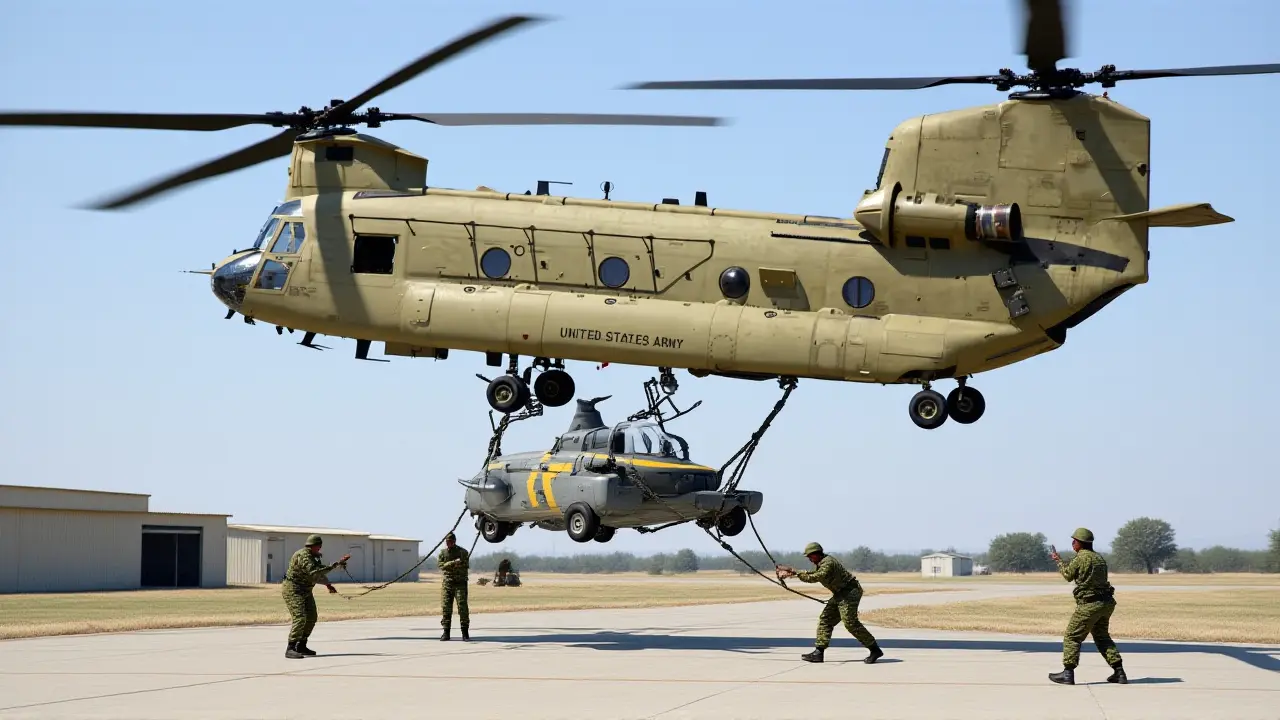
The quest for fully autonomous military aviation often feels like a race toward a futuristic horizon, but the current reality for the Boeing CH-47F Chinook is far more grounded. Despite the buzz surrounding unmanned systems, there is currently no confirmed evidence or official reporting that a CH-47F Chinook has performed a complete autonomous landing without any human input. While the military is pushing for higher levels of automation, the heavy-lift workhorse remains firmly under the control of its flight crew.
Here's the thing: in the world of defense contracting, there's often a gap between "experimental capability" and "operational reality." While many assume that a modern Block II variant would have "autopilot on steroids," the technical hurdle of landing a massive tandem-rotor aircraft without a human hand on the cyclic is a different beast entirely. The absence of data on autonomous landings isn't necessarily a failure, but it highlights a critical boundary in current rotorcraft technology.
The Block II Evolution and the 2019 Milestones
To understand where we stand, we have to look at the Boeing CH-47F Block II program. This isn't just a fancy paint job; it's a significant overhaul of the aircraft's internal organs. A pivotal moment occurred on the Block II prototype test flightMesa, Arizona, where the aircraft underwent rigorous testing at the Boeing Test Flight Facility.
The results from that 2019 window were impressive, but not in the way some sci-fi enthusiasts hope. The focus was on "hard" engineering rather than "soft" AI. The prototype showcased an improved drivetrain and a revamped rotor system, utilizing advanced blade technology to increase lift and efficiency. But let's be clear: that flight involved traditional crewed operations. Pilots were in the seats, making the decisions, and handling the landing. The "intelligence" added to the Block II is primarily about mechanical reliability and fuel efficiency, not removing the human from the cockpit.
- Maiden Flight: The original Chinook first flew on September 21, 1961.
- Block II Milestone: Experimental flight completed November 7, 2019, in Mesa, Arizona.
- Primary Upgrades: Focus on drivetrain, rotor blades, and lifting capacity.
- Autonomy Level: No verified human-free autonomous landing recorded.
The Challenge of Autonomous Heavy Lift
Why is it so hard to make a Chinook land itself? Turns out, landing a tandem-rotor helicopter is vastly different from landing a quadcopter or a small drone. The CH-47F deals with immense weight and complex aerodynamic interactions between its two massive rotors. To achieve a truly autonomous landing—one where a computer manages the descent, compensates for wind shear, and touches down without a pilot's correction—requires a level of sensor fusion that is still in the testing phases for heavy-lift aircraft.
Interestingly, the military does use "automated flight control systems" (AFCS), which can hold a hover or follow a pre-set path. But there's a world of difference between a computer keeping the aircraft steady and a computer deciding exactly when and where to put the wheels on the ground in a combat zone. The risk of a "hard landing" (which is military speak for a crash) is too high to trust entirely to an algorithm.
Perspectives from the Hangar
Within the aviation community, there's a healthy debate about the necessity of these systems. Some proponents argue that autonomous landing is essential for "unmanned logistics," allowing the United States Army to move supplies into dangerous territory without risking pilots. They point to the success of smaller UAVs as a proof of concept.
On the other side, veteran pilots argue that the "human in the loop" is irreplaceable. A pilot can sense a shift in the wind or see a debris field on the landing zone that a sensor might miss. For them, the Block II's focus on a better drivetrain and rotor system is far more valuable than a risky autonomous landing feature that might fail at the most critical moment.
What This Means for the Future of Military Tech
The ripple effects of this technology gap are significant. If Boeing eventually cracks the code on autonomous heavy-lift landings, it would change the face of casualty evacuation (CASEVAC) and troop insertion. Imagine a Chinook that can drop off a squad of soldiers in a hot zone and return to base entirely unmanned.
But for now, the timeline remains speculative. We are seeing a gradual shift toward "optionally piloted" aircraft, where the human can either fly the plane or supervise the AI. The transition won't happen overnight. It will likely move from assisted landings (where the AI does 90% of the work) to fully autonomous operations over the next decade.
A Legacy of Reliability
It's easy to get caught up in the AI hype, but the Chinook's real story is its longevity. From its first flight in September 1961 to the current Block II iterations, the aircraft has survived because it is fundamentally a rugged piece of machinery. The focus on the rotor system in Mesa, Arizona, proves that the industry still prioritizes physics over software.
By improving the drivetrain, the military is ensuring the CH-47F can operate in higher, hotter environments—essentially giving the aircraft more "muscle." Once the muscle is perfected, the "brain" (the autonomous systems) will eventually follow. Until then, the pilots stay in the cockpit.
Frequently Asked Questions
Did the CH-47F Block II prototype test autonomous landing?
No. The test flight on November 7, 2019, in Mesa, Arizona, focused on the improved drivetrain, rotor system, and advanced blade technology. These were traditional crewed operations, meaning pilots were in control throughout the flight and landing process.
What is the difference between an AFCS and autonomous landing?
An Automated Flight Control System (AFCS) helps a pilot maintain stability, hover, or follow a heading, acting as a sophisticated cruise control. Autonomous landing, however, requires the aircraft to independently identify a landing zone, calculate a descent path, and execute the touchdown without any human intervention.
Why are autonomous landings difficult for the Chinook?
The Chinook's tandem-rotor design creates complex aerodynamic interactions. Managing the weight of a heavy-lift helicopter during the "ground effect" phase of landing requires precision that current AI sensors often struggle to replicate perfectly in unpredictable weather or combat environments.
When was the original CH-47 Chinook first flown?
The original Boeing CH-47 Chinook made its maiden flight on September 21, 1961. Since then, it has evolved through multiple versions, culminating in the current CH-47F and the advanced Block II variant.
Gary Clement
April 23, 2026 AT 00:09totally agree with the focus on physics first. the tandem rotor setup is a nightmare for sensors because of the downwash and ground effect interactions. getting a computer to handle that transition without slamming the bird into the dirt is a massive task. basically you need real time terrain mapping and insane wind compensation that just isn't ready for a 20 ton aircraft yet
Antony Bachtiar
April 24, 2026 AT 18:43smh at people thinking this is a "gap". its called safety. why the hell would you want to automate a heavy lift landing in a war zone where the LZ might have a crater or a tank in the way. id rather have a human pilot who can actually see things instead of some glitchy code crashin the whole rig. boeing is just doin it right by focusin on the engine and blades instead of some sci-fi nonsense
Aaron X
April 25, 2026 AT 20:46The ontological divide between an Automated Flight Control System and true autonomy is essentially a question of heuristic decision-making versus deterministic execution. We are discussing the transition from a closed-loop control system to a cognitive architecture capable of navigating stochastic environments. The inherent instability of the tandem-rotor aerodynamic profile introduces a level of entropy that current sensor-fusion algorithms cannot effectively mitigate without a human cognitive layer to resolve ambiguity in the landing zone telemetry.
nikolai kingsley
April 27, 2026 AT 06:37ridiculus that we spend billions on this stuff and cant even land a helicopter by itself when drones do it every day. total waste of tax payer money honestly. boeing probly just hideing the failures lol
Shelley Brinkley
April 28, 2026 AT 23:32lol imagine believng this is a "milestone" just because they fixed the drivetrain. its basic maintenence not evolution. the whole block ii is just a way for boeing to overcharge the govt for stuff that shouldve been done in the 90s
Beth Elwood
April 29, 2026 AT 22:14The drivetrain upgrades are actually huge for high-density altitude operations! 🏔️ Better lift capacity means more troops or more gear can get moved in mountain environments where air is thin. It's all about the physics of lift before the software takes over 🚁✨
Josh Raine
April 30, 2026 AT 05:05Why do we always prioritize the machine over the man? 🙄 It is absolutely infuriating that people think a piece of software can replace the intuition of a veteran pilot who has survived ten tours! You can't program a "gut feeling" about a wind shift that's about to flip a helicopter over! It is an insult to the profession to even suggest that a computer could handle a hot LZ with the same precision as a human! I honestly cannot wrap my head around the obsession with removing the pilot from the loop just to save a few lives while risking the entire mission! It is a dangerous gamble and a complete disregard for the nuance of aerial combat! 😡
Mason Interactive
May 1, 2026 AT 06:00It is pretty wild how the Chinook has just kept evolving since the 60s. Most things from that era are in museums, but this thing is still the gold standard for heavy lift. Just shows that if you build something rugged enough, you can just keep upgrading the internals forever.
Dianna Knight
May 3, 2026 AT 05:11The transition to optionally piloted vehicles is such a fascinating evolution in aerospace engineering! 🌟 I love how it balances the need for reduced risk to personnel with the critical need for human oversight in high-stakes environments. The integration of advanced rotor blade metallurgy really complements the potential for future AI guidance systems. It's all about creating a robust hardware foundation first! 😊
Mel Alm
May 4, 2026 AT 14:19im glad they are focusin on the mechanical stuff first. better to have a strong aircraft than a smart one that crashes because of a bug in the code
Angie Khupe
May 5, 2026 AT 02:44I think both sides have a point here. It would be great for safety, but the pilots' experience is so valuable too. Maybe there is a middle ground where the AI helps but the pilot has the final say? :)
Arun Prasath
May 6, 2026 AT 05:43The distinction between the AFCS and full autonomy is a critical point for understanding current aviation limitations. It is important to note that stability augmentation is not equivalent to autonomous decision-making. The reliance on human intervention for the final touchdown phase ensures maximum safety given the current state of sensor fusion technology.
Alex Green international
May 7, 2026 AT 20:20It is truly commendable that the focus remains on the reliability of the aircraft's mechanical systems first. Prioritizing the drivetrain and rotor efficiency ensures the safety of the crew and the success of the mission above all else